 |
|
Please Whitelist This Site?
I know everyone hates ads. But please understand that I am providing premium content for free that takes hundreds of hours of time to research and write. I don't want to go to a pay-only model like some sites, but when more and more people block ads, I end up working for free. And I have a family to support, just like you. :)
If you like The TCP/IP Guide, please consider the download version. It's priced very economically and you can read all of it in a convenient format without ads.
If you want to use this site for free, I'd be grateful if you could add the site to the whitelist for Adblock. To do so, just open the Adblock menu and select "Disable on tcpipguide.com". Or go to the Tools menu and select "Adblock Plus Preferences...". Then click "Add Filter..." at the bottom, and add this string: "@@||tcpipguide.com^$document". Then just click OK.
Thanks for your understanding!
Sincerely, Charles Kozierok
Author and Publisher, The TCP/IP Guide

|
|

|

Custom Search
|

|


RIP Version 1 (RIP-1) Message Format
(Page 2 of 3)
RIP-1 Message Format
The basic message format for RIP-1 is described in Table 120 and illustrated in Figure 176.
Field Name |
Size (bytes) |
Description |
Command |
1 |
Command Type: Identifies the type of RIP message being sent. A value of 1 indicates an RIP Request, while 2 means an RIP Response. Originally, three other values and commands were also defined: 3 and 4 for the Traceon and Traceoff commands, and 5 reserved for use by Sun Microsystems. These are obsolete and no longer used. |
Version |
1 |
Version Number: Set to 1 for RIP version 1. |
Must Be Zero |
2 |
Reserved: Field reserved; value must be set to all zeroes. |
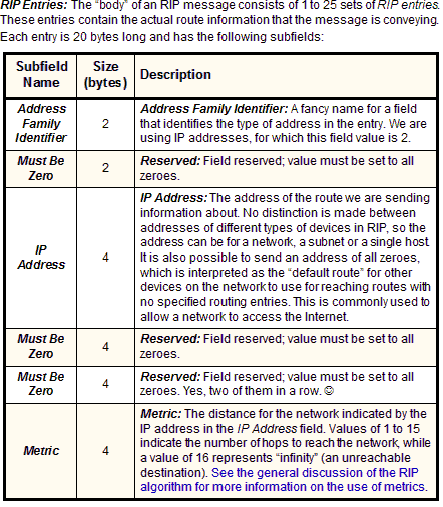
RIP Entries |
20 to 500, in increments of 20 |
|
|
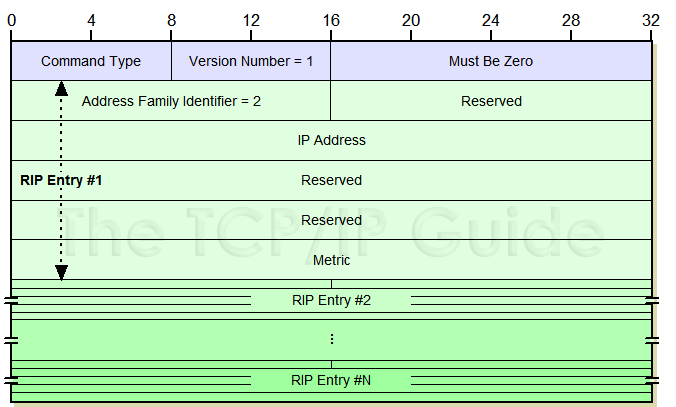
If you're like me, the first thing that comes to mind looking at this message format is this: what's with all the extra space? I mean, we have four different fields that are reserved (must be zero), and even most of the other fields are larger than they need to be (a metric of 1 to 16 needs only 4 bits, not 32.) The command type and version number could easily have been made only 4 bits each as well (if not less.) And why bother having a two-byte field to identify the address type when we are only going to deal with IP addresses anyway?
This seeming wastefulness is actually an artifact of the generality of the original RIP design. The protocol was intended to be able to support routing for a variety of different internetworking protocols, not just IP. (Remember that it wasn't even originally developed with IP in mind.) So, the Address Family Identifier was included to specify address type, and RIP entries were made large enough to handle large addresses. IP only requires 4 bytes per address so some of the space is not used.
|
| |||||||||||||||||||
Home - Table Of Contents - Contact Us
The TCP/IP Guide (http://www.TCPIPGuide.com)
Version 3.0 - Version Date: September 20, 2005
© Copyright 2001-2005 Charles M. Kozierok. All Rights Reserved.
Not responsible for any loss resulting from the use of this site.