 |
|
Please Whitelist This Site?
I know everyone hates ads. But please understand that I am providing premium content for free that takes hundreds of hours of time to research and write. I don't want to go to a pay-only model like some sites, but when more and more people block ads, I end up working for free. And I have a family to support, just like you. :)
If you like The TCP/IP Guide, please consider the download version. It's priced very economically and you can read all of it in a convenient format without ads.
If you want to use this site for free, I'd be grateful if you could add the site to the whitelist for Adblock. To do so, just open the Adblock menu and select "Disable on tcpipguide.com". Or go to the Tools menu and select "Adblock Plus Preferences...". Then click "Add Filter..." at the bottom, and add this string: "@@||tcpipguide.com^$document". Then just click OK.
Thanks for your understanding!
Sincerely, Charles Kozierok
Author and Publisher, The TCP/IP Guide

|
|

|

Custom Search
|

|


ICMP Common Message Format and Data Encapsulation
(Page 1 of 2)
As we have seen in the preceding topics, ICMP is not so much a protocol that performs a specific function as a framework for the exchange of error reports and information. Since each of the message types is used for a different purpose, they differ in the types of information each contains. This means each ICMP message has a slightly different format. At the same time, however, ICMP message types also have a degree of commonality—a portion of each message is common between message types.
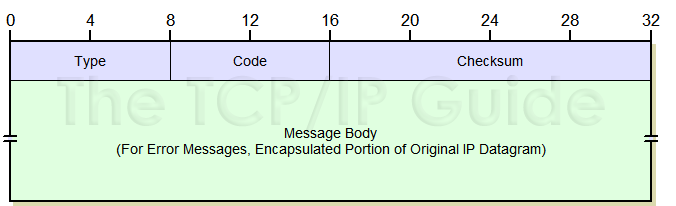
The structure of an ICMP message can be generally thought of as having a common part and a unique part. The common part consists of three fields that have the same size and same meaning in all ICMP messages (though the values in the fields aren't the same for each ICMP message type, of course). The unique part contains fields that are specific to each type of message.
Interestingly, the common message format is basically the same for ICMPv4 and ICMPv6. It is described in Table 87 and Figure 138.
Field Name |
Size (bytes) |
Description |
Type |
1 |
Type: Identifies the ICMP message type. For ICMPv6, values from 0 to 127 are error messages and values 128 to 255 are informational messages. Common values for this field are given in the table in the topic on ICMP message classes and types. |
Code |
1 |
Code: Identifies the “subtype” of message within each ICMP message Type value. Thus, up to 256 “subtypes” can be defined for each message type. Values for this field are shown in the individual ICMP message type topics. |
Checksum |
2 |
Checksum: 16-bit checksum field that is calculated in a manner similar to the IP header checksum in IPv4. It provides error detection coverage for the entire ICMP message. Note that in ICMPv6, a pseudo-header of IPv6 header fields is prepended for checksum calculation; this is similar to the way this is done in TCP. |
Message |
Variable |
Message Body: Contains the specific fields used to implement each message type. This is the unique part of the message as I mentioned above. |
The message body typically contains one or several fields that carry information of relevance to each specific type of ICMP message. For error messages, we see here one more area of commonality in ICMP messages: all ICMP error messages include a portion of the original IP datagram that led to the ICMP error message. This aids in diagnosing the problem that caused the ICMP message to be generated, by allowing the error to be communicated to higher layers.
|
|
| |||||||||||||||||||
Home - Table Of Contents - Contact Us
The TCP/IP Guide (http://www.TCPIPGuide.com)
Version 3.0 - Version Date: September 20, 2005
© Copyright 2001-2005 Charles M. Kozierok. All Rights Reserved.
Not responsible for any loss resulting from the use of this site.