 |
|
Please Whitelist This Site?
I know everyone hates ads. But please understand that I am providing premium content for free that takes hundreds of hours of time to research and write. I don't want to go to a pay-only model like some sites, but when more and more people block ads, I end up working for free. And I have a family to support, just like you. :)
If you like The TCP/IP Guide, please consider the download version. It's priced very economically and you can read all of it in a convenient format without ads.
If you want to use this site for free, I'd be grateful if you could add the site to the whitelist for Adblock. To do so, just open the Adblock menu and select "Disable on tcpipguide.com". Or go to the Tools menu and select "Adblock Plus Preferences...". Then click "Add Filter..." at the bottom, and add this string: "@@||tcpipguide.com^$document". Then just click OK.
Thanks for your understanding!
Sincerely, Charles Kozierok
Author and Publisher, The TCP/IP Guide

|
|
|

Custom Search
|

|


World Wide Web System Concepts and Components
(Page 1 of 3)
Hypertext is the main concept that makes the World Wide Web more than just another message transfer system. However, the idea behind hypertext had been around for decades before the Web was born, as had certain software products based on that idea. Obviously, more than just a concept is needed for an idea to be developed into a successful system.
The Web became a phenomenon because it combined the basic idea of hypertext with several other concepts and technologies, to create a rich, comprehensive mechanism for interactive communication. This system today encompasses so many different concepts and software elements, and is so integrated with other technologies, that it's hard to find any two people who agree on what exactly comprises the Web, and which are most critical parts.
For example, one of the keys to the success of the World Wide Web is undeniably the combination of the TCP/IP internetworking protocol suite and the Internet infrastructure that connects together the computers of the world. Is the Internet then an essential component of the World Wide Web? In many ways it is; and in fact, due to how popular the Web is today, it is common to hear people call the Web “the Internet”.
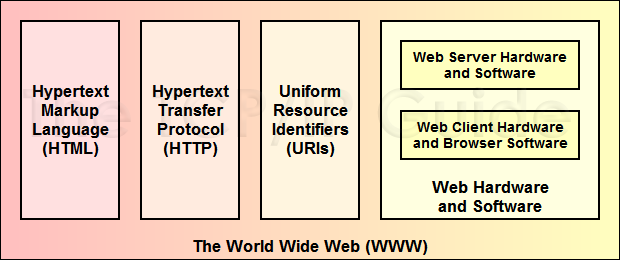
The functional components of the World Wide Web are illustrated in Figure 314. Let’s take a look at them in a bit more detail now.
|
|
| |||||||||||||||||||
Home - Table Of Contents - Contact Us
The TCP/IP Guide (http://www.TCPIPGuide.com)
Version 3.0 - Version Date: September 20, 2005
© Copyright 2001-2005 Charles M. Kozierok. All Rights Reserved.
Not responsible for any loss resulting from the use of this site.