 |
|
Please Whitelist This Site?
I know everyone hates ads. But please understand that I am providing premium content for free that takes hundreds of hours of time to research and write. I don't want to go to a pay-only model like some sites, but when more and more people block ads, I end up working for free. And I have a family to support, just like you. :)
If you like The TCP/IP Guide, please consider the download version. It's priced very economically and you can read all of it in a convenient format without ads.
If you want to use this site for free, I'd be grateful if you could add the site to the whitelist for Adblock. To do so, just open the Adblock menu and select "Disable on tcpipguide.com". Or go to the Tools menu and select "Adblock Plus Preferences...". Then click "Add Filter..." at the bottom, and add this string: "@@||tcpipguide.com^$document". Then just click OK.
Thanks for your understanding!
Sincerely, Charles Kozierok
Author and Publisher, The TCP/IP Guide

|
|
|

Custom Search
|

|


Usenet Addressing: Newsgroups, Newsgroup Hierarchies and Types
(Page 3 of 4)
Other Newsgroup Hierarchies
For those who prefer a more free-wheeling environment and do not want to submit to the Big Eight procedures, there is the “alternative” Usenet hierarchy, which begins with the hierarchy name alt. This hierarchy includes many thousands of groups. Some are quite popular, but many are not used at all; this is a side-effect of the relative ease with which an alt group can be created.
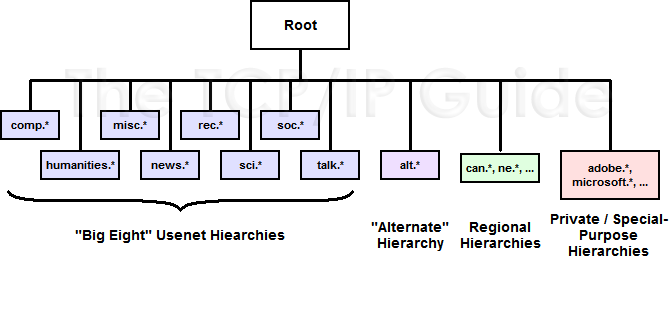
In addition to these nine hierarchies there are dozens of additional, smaller hierarchies. Many of these are regional or even company-specific. For example, the “ne.” hierarchy contains a set of newsgroups discussing issues of relevance to New England; “fr.*” covers France, and “de.*” Germany. Microsoft has its own set of public newsgroups in the “microsoft.*” hierarchy. Figure 311 shows the Big Eight hierarchies and some of the other hierarchies that exist.
|
|
 Key Concept: Usenet messages are not addressed to individual users; rather, they are posted to newsgroups. Each newsgroup represents a topic; those with an interest in the subject of a group can read messages in it, and reply to them as well. Usenet newsgroups are arranged into tree-like hierarchies that are similar in structure to DNS domains. Many of the most widely-used newsgroups are found in a collection of general-interest hierarchies called the Big Eight. There are also many regional and special-purpose hierarchies.
|
| |||||||||||||||||||
Home - Table Of Contents - Contact Us
The TCP/IP Guide (http://www.TCPIPGuide.com)
Version 3.0 - Version Date: September 20, 2005
© Copyright 2001-2005 Charles M. Kozierok. All Rights Reserved.
Not responsible for any loss resulting from the use of this site.