 |
|
Please Whitelist This Site?
I know everyone hates ads. But please understand that I am providing premium content for free that takes hundreds of hours of time to research and write. I don't want to go to a pay-only model like some sites, but when more and more people block ads, I end up working for free. And I have a family to support, just like you. :)
If you like The TCP/IP Guide, please consider the download version. It's priced very economically and you can read all of it in a convenient format without ads.
If you want to use this site for free, I'd be grateful if you could add the site to the whitelist for Adblock. To do so, just open the Adblock menu and select "Disable on tcpipguide.com". Or go to the Tools menu and select "Adblock Plus Preferences...". Then click "Add Filter..." at the bottom, and add this string: "@@||tcpipguide.com^$document". Then just click OK.
Thanks for your understanding!
Sincerely, Charles Kozierok
Author and Publisher, The TCP/IP Guide

|
|
|

Custom Search
|

|


PPP Multilink Protocol (MP) Frame Format
(Page 3 of 4)
PPP Multilink Protocol Fragment Frame Format
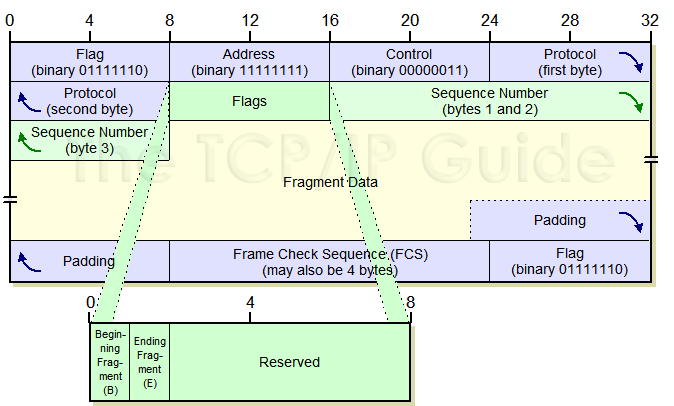
The Information field of each fragment uses a substructure that contains a four-field MP header along with one fragment of the original PPP frame, as shown in Table 41.
|
|
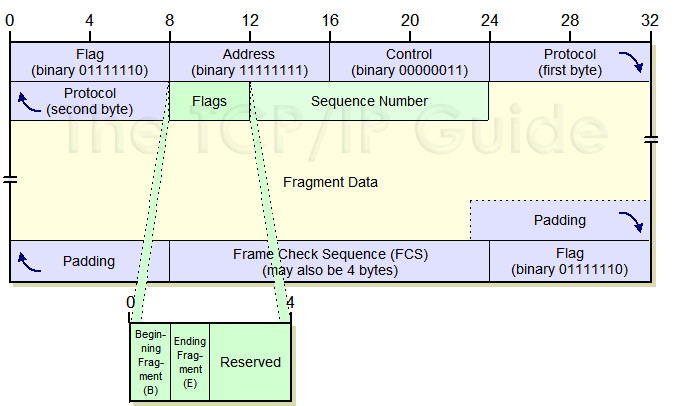
As you can see, the MP frame format comes in two versions: the long format uses a 4-byte header, while the short format requires only 2 bytes. The default MP header format uses a 24-bit Sequence Number and has 6 reserved bits, as shown in Figure 41. It is possible when MP is set up, for devices to negotiate the Multilink Short Sequence Number Header Format configuration option. If this is done successfully, shorter 12-bit Sequence Numbers are used instead. Four of the reserved bits are also truncated, to save 2 bytes on each frame, as illustrated in Figure 42. (Considering that 12 bits still allows for over 4,000 fragments per PPP frame, this is usually more than enough!)
The Fragment Data field contains the actual fragment to be sent. Since the original PPP header (including the Protocol field) is at the start of the original PPP frame, this will appear at the start of the first fragment. The remaining fragments will have just portions of the Information field of the original PPP frame. The last fragment will end with the last bytes of the original PPP frame.
The receiving device will collect all the fragments for each PPP frame, extract the fragment data and MP headers from each. It will use the Sequence Numbers to reassemble the fragments and then process the resulting PPP frame.
|
| |||||||||||||||||||
Home - Table Of Contents - Contact Us
The TCP/IP Guide (http://www.TCPIPGuide.com)
Version 3.0 - Version Date: September 20, 2005
© Copyright 2001-2005 Charles M. Kozierok. All Rights Reserved.
Not responsible for any loss resulting from the use of this site.