 |
|
Please Whitelist This Site?
I know everyone hates ads. But please understand that I am providing premium content for free that takes hundreds of hours of time to research and write. I don't want to go to a pay-only model like some sites, but when more and more people block ads, I end up working for free. And I have a family to support, just like you. :)
If you like The TCP/IP Guide, please consider the download version. It's priced very economically and you can read all of it in a convenient format without ads.
If you want to use this site for free, I'd be grateful if you could add the site to the whitelist for Adblock. To do so, just open the Adblock menu and select "Disable on tcpipguide.com". Or go to the Tools menu and select "Adblock Plus Preferences...". Then click "Add Filter..." at the bottom, and add this string: "@@||tcpipguide.com^$document". Then just click OK.
Thanks for your understanding!
Sincerely, Charles Kozierok
Author and Publisher, The TCP/IP Guide

|
|
|

Custom Search
|

|


PPP Components and General Operation
(Page 2 of 2)
PPP General Operation
The fact that the PPP suite includes literally dozens of protocols often makes it seem like it must be a really complex technology. In fact, the general operation of PPP is really quite straight-forward. The existence of all those PPP protocols allows PPP to be flexible and extensible, supporting many higher layer datagram types and various features.
The bottom line, however, is that PPP operation involves just three basic steps. Beginning in a state where there is no PPP link between the devices, these are the operations that occur in PPP (also illustrated in Figure 24):
- Link Setup and Configuration:
Before the two devices can exchange information, they must make contact
and set up a link between them. During link setup, all the parameters
needed to manage the operation of the link are agreed upon by the two
devices. The LCP begins this process, and invokes the help of support
protocols as they are needed, for options like authentication. After
the link is set up in general terms, the appropriate NCP is called for
whatever layer three technology is being carried on the link to complete
link setup.
- Link Operation: The devices
on the link use it to send datagrams. Each device transmits by taking
layer three datagrams, encapsulating them and sending them down to layer
one to be transmitted. Each device receives by taking PPP frames sent
up from its own physical layer, stripping off the PPP header and passing
the datagram up to layer three. Where appropriate, optional feature
protocols are used here, such as CCP for compression.
- Link Termination: When either
device decides it no longer wants to communicate, it terminates the
link. The link can of course be re-established if desired.
Figure 24: Overview of PPP Operation
In simplest terms, PPP consists of only three basic steps: link setup, link operation and link termination.
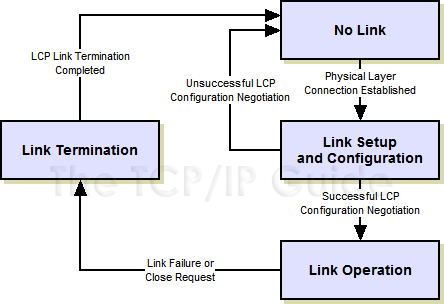
Link setup is by far the most complicated of these general steps, as it involves several substeps used to negotiate link parameters and options. The next topic describes the steps in link setup, and discusses the phases that a link passes through as it is set up, used, and eventually terminated.
|
| |||||||||||||||||||
Home - Table Of Contents - Contact Us
The TCP/IP Guide (http://www.TCPIPGuide.com)
Version 3.0 - Version Date: September 20, 2005
© Copyright 2001-2005 Charles M. Kozierok. All Rights Reserved.
Not responsible for any loss resulting from the use of this site.