 |
|
Please Whitelist This Site?
I know everyone hates ads. But please understand that I am providing premium content for free that takes hundreds of hours of time to research and write. I don't want to go to a pay-only model like some sites, but when more and more people block ads, I end up working for free. And I have a family to support, just like you. :)
If you like The TCP/IP Guide, please consider the download version. It's priced very economically and you can read all of it in a convenient format without ads.
If you want to use this site for free, I'd be grateful if you could add the site to the whitelist for Adblock. To do so, just open the Adblock menu and select "Disable on tcpipguide.com". Or go to the Tools menu and select "Adblock Plus Preferences...". Then click "Add Filter..." at the bottom, and add this string: "@@||tcpipguide.com^$document". Then just click OK.
Thanks for your understanding!
Sincerely, Charles Kozierok
Author and Publisher, The TCP/IP Guide

|
|
|

Custom Search
|

|


OSPF Route Determination Using SPF Trees
(Page 2 of 4)
OSPF Route Determination Example
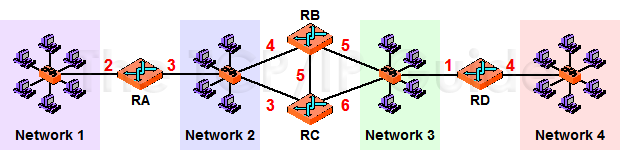
I can almost see your eyes glazing over, so let's go back again to the example we have been using in this section. I am going to assume we are looking at the whole AS as a whole in basic topology, for simplicity. In Table 124, I have repeated the LSDB for this AS, and I have taken the liberty of replacing the “[“s with cost metrics; these are shown in Figure 181 as well. Again, remember there is no cost to reach a router from a network, so those links have a non-zero cost only going from the router to the network.
To Router / Network |
From Router |
From Network |
||||||
RA |
RB |
RC |
RD |
N1 |
N2 |
N3 |
N4 |
|
RA |
|
|
|
|
0 |
0 |
|
|
RB |
|
|
5 |
|
|
0 |
0 |
|
RC |
|
5 |
|
|
|
0 |
0 |
|
RD |
|
|
|
|
|
|
0 |
0 |
N1 |
2 |
|
|
|
|
|
|
|
N2 |
3 |
4 |
3 |
|
|
|
|
|
N3 |
|
5 |
6 |
1 |
|
|
|
|
N4 |
|
|
|
4 |
|
|
|
|
|
Now, let's construct the SPF tree for RC. We can do this in iterations, as follows (this is shown graphically in Figure 182 as well for your convenience):
|
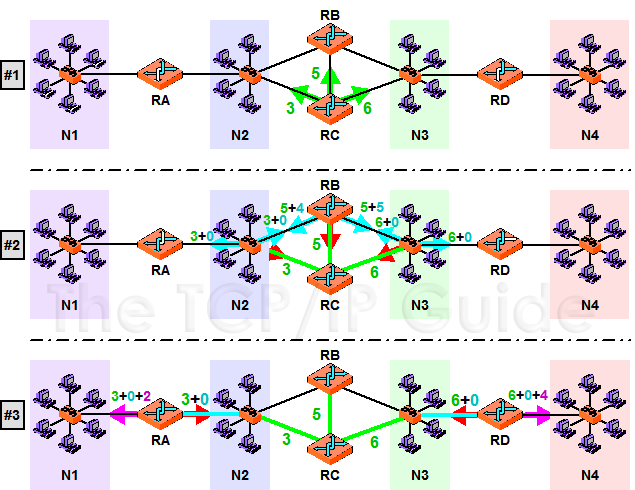
To construct the first level of the tree, we look for all devices that RC can reach directly. We find:
- RB, with a cost of 5.
- N2, with a cost of 3.
- N3, with a cost of 6.
|
| |||||||||||||||||||
Home - Table Of Contents - Contact Us
The TCP/IP Guide (http://www.TCPIPGuide.com)
Version 3.0 - Version Date: September 20, 2005
© Copyright 2001-2005 Charles M. Kozierok. All Rights Reserved.
Not responsible for any loss resulting from the use of this site.