 |
|
Please Whitelist This Site?
I know everyone hates ads. But please understand that I am providing premium content for free that takes hundreds of hours of time to research and write. I don't want to go to a pay-only model like some sites, but when more and more people block ads, I end up working for free. And I have a family to support, just like you. :)
If you like The TCP/IP Guide, please consider the download version. It's priced very economically and you can read all of it in a convenient format without ads.
If you want to use this site for free, I'd be grateful if you could add the site to the whitelist for Adblock. To do so, just open the Adblock menu and select "Disable on tcpipguide.com". Or go to the Tools menu and select "Adblock Plus Preferences...". Then click "Add Filter..." at the bottom, and add this string: "@@||tcpipguide.com^$document". Then just click OK.
Thanks for your understanding!
Sincerely, Charles Kozierok
Author and Publisher, The TCP/IP Guide

|
|

|

Custom Search
|

|


IPv6 ND General Operational Overview: ND Functions, Functional Groups and Message Types
(Page 1 of 3)
As I mentioned in the preceding overview, the name of the Neighbor Discovery (ND) protocol really does not do it justice. The protocol facilitates not merely the discovery of neighboring devices, but a substantial number of functions related to local network connectivity, datagram routing and configuration. Both regular hosts and routers in an IPv6 environment count on the ND protocol to facilitate important exchanges of information that are necessary for proper internetwork operation.
The Neighbor Discovery protocol has a number of similarities to the Internet Control Message Protocol. An important one is that like ICMP, ND is a messaging protocol. It doesn't implement a single specific function but rather a group of activities that are performed through the exchange of messages. This means we can't explain the operation of ND through a specific description of “what ND does”, but rather must define its operation by means of a list of messages ND provides and specific ways that they are used.
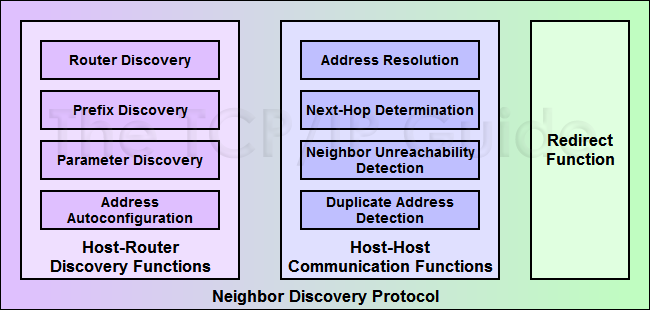
Any local network on an internet will have both regular hosts and routers, and the term neighbor can refer to either. Of course, hosts and routers play different roles on a network, and as a result neighbor discovery is very different for each. The ND standard describes nine specific functions performed by the protocol. To better understand these functions and how they are related, we can divide them into three functional groups based on communication type and the kinds of devices involved (see Figure 169).
|
|
| |||||||||||||||||||
Home - Table Of Contents - Contact Us
The TCP/IP Guide (http://www.TCPIPGuide.com)
Version 3.0 - Version Date: September 20, 2005
© Copyright 2001-2005 Charles M. Kozierok. All Rights Reserved.
Not responsible for any loss resulting from the use of this site.